
Refrigerator Compressor Repair: Why It Won’t Start, Clicks, or Runs Without Cooling
Your fridge isn’t cooling, and you’ve been told it’s the compressor. Maybe a technician said it. Maybe you looked it up yourself and reached that conclusion. Either way, the word “compressor” usually means an expensive repair — or a new fridge.
Here’s what most people don’t realise: a significant proportion of “compressor failures” aren’t compressor failures at all. They’re failed start relays, blown capacitors, or tripped overload protectors — external components that cost $10 to $25 and plug directly onto the compressor. The compressor itself is often perfectly healthy.
The distinction matters enormously. A $15 start relay is a five-minute fix. A genuine compressor failure costs $400 to $600 to repair professionally, which on most domestic fridges means replacement. This guide teaches you how to tell the difference with certainty before you spend money on either.
Common Symptoms
-
Compressor clicks repeatedly but never starts
-
Compressor hums loudly for a few seconds then stops
-
Compressor is completely silent, fridge is warm
-
Compressor runs continuously but the fridge doesn’t cool
-
Compressor runs but never cycles off
-
Loud rattling, knocking, or grinding from the compressor area
-
Compressor short cycles — starts then stops repeatedly
-
Fridge trips the circuit breaker when the compressor tries to start
-
Error code on the display pointing to the compressor or inverter
What Causes Compressor-Related Faults
-
Failed start relay — the most common cause. A $10 to $20 part that plugs onto the compressor terminals. The compressor clicks or chatters but won’t start.
-
Failed start capacitor — the compressor hums but doesn’t turn. A $10 to $20 part.
-
Failed run capacitor — the compressor runs hot, draws excessive current, and eventually trips the overload.
-
Failed overload protector — cuts power too early, causing short cycling. A $5 to $10 part.
-
Failed thermostat or control board — the compressor never receives the signal to run.
-
Failed compressor windings — the motor windings are open or shorted. A genuine compressor failure.
-
Seized compressor — mechanically locked. Cannot be repaired.
-
Refrigerant leak — the compressor runs but doesn’t cool because there’s nothing to pump.
-
Failed inverter board — on modern inverter compressors, the control board fails and the compressor won’t run.
What the Guide Covers
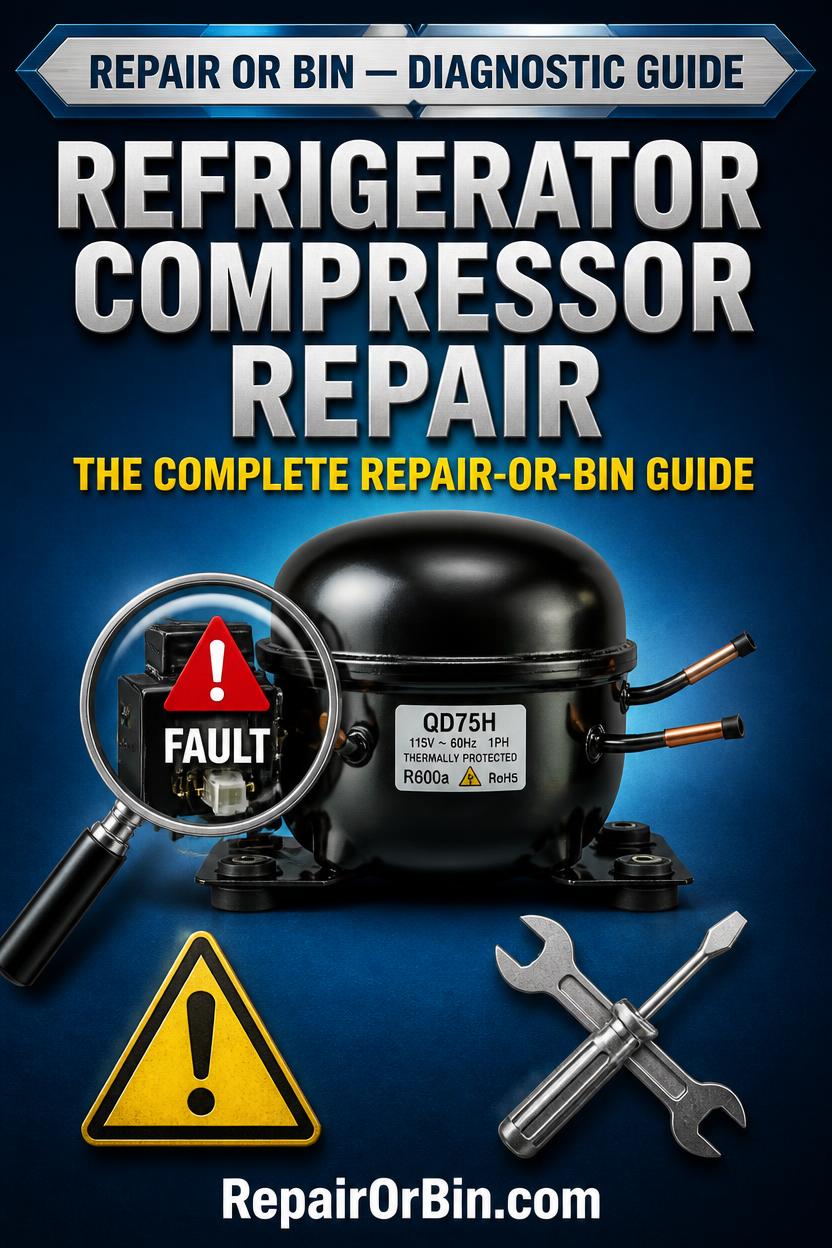
The Refrigerator Compressor Repair guide is a complete 15-page diagnostic reference covering every compressor-related fault:
-
Start relay testing and replacement — the most common fix, with multimeter procedures and part matching by compressor model
-
Start and run capacitor testing — including the safe discharge procedure and capacitance measurement
-
Overload protector diagnosis — how to test for continuity and identify a protector that trips too early
-
Compressor winding tests — measuring resistance between the Common, Start, and Run terminals, and testing for shorts to ground
-
Thermostat and control board diagnosis — confirming the compressor is actually being told to run
-
Inverter compressor diagnosis — testing the inverter board and compressor windings on modern variable-speed systems
-
Sealed system fault identification — recognising a refrigerant leak or internal compressor failure from the symptoms
-
Compressor noise diagnosis — distinguishing normal compressor hum from failing bearings or internal mechanical failure
-
Repair cost reference — typical parts and labour costs for every fault covered
-
Repair-versus-replace framework — with clear thresholds for when a compressor fault means the fridge is finished
What You’ll Learn
You’ll learn how the compressor start circuit works — the three terminals, the start winding, the run winding, and the role of the start relay and capacitor. Once you understand that, the diagnostic sequence becomes obvious.
You’ll learn how to test a start relay by shaking it, measuring its resistance, and matching a replacement to the compressor model rather than just the fridge model. You’ll learn how to test capacitors safely, how to measure compressor windings, and how to tell a compressor fault from a sealed system fault.
You’ll learn the crucial difference between a compressor that won’t run and a compressor that runs but doesn’t pump. The first is often a cheap external component. The second is almost always a terminal diagnosis.
And you’ll learn the threshold that matters most: when a $15 relay fixes the problem, and when a genuine compressor failure means replacement is the only sensible option.
Repair or Bin?
This is where the fridge repair calculation gets sharp.
-
Start relay — $10 to $20. Always worth replacing.
-
Start or run capacitor — $10 to $25. Always worth replacing.
-
Overload protector — $5 to $10. Always worth replacing.
-
Thermostat — $15 to $30. Worth replacing on any fridge.
-
Control board — $60 to $150. Worth it on fridges under eight years old.
-
Inverter board — $100 to $250. Worth it on fridges under seven years old.
-
Compressor replacement — $400 to $600 including labour. Bin decision on fridges over five years old.
-
Sealed system repair — $400 to $600. Same calculation.
The guide walks through each scenario with worked examples, so you know exactly where your fridge falls.
Frequently Asked Questions
Why does my fridge compressor click but not start?
A failed start relay. The relay attempts to start the compressor, fails, and the overload protector trips — that’s the click. A replacement relay costs $10 to $20 and takes five minutes to fit.
Why does my fridge compressor hum but not cool?
Two possibilities. Either the start capacitor has failed (the compressor can’t start spinning), or the compressor runs but the sealed system has lost its refrigerant. The guide explains how to tell them apart.
Is a failed compressor worth replacing?
Rarely. A compressor replacement costs $400 to $600 including labour. On a fridge over five years old, that’s almost always more than the fridge is worth. The exceptions are premium or built-in models where replacement cost is much higher.
How do I test a fridge compressor?
Measure resistance between the three terminals — Common, Start, and Run. The highest reading should be between Start and Run. If any winding shows infinite resistance or a short to ground, the compressor has failed. The guide explains the full procedure.
Can I replace a fridge compressor myself?
No. Compressor replacement requires recovering the refrigerant, brazing new lines, evacuating the system, and recharging with the correct refrigerant. This requires specialist equipment and a licence in most jurisdictions.
Get the Complete Refrigerator Compressor Repair Guide
Stop assuming the worst. This guide teaches you how to test every component in the compressor circuit — and how to tell a $15 fix from a $500 repair.
Refrigerator Compressor Repair — $7.95
Know the fault. Fix it properly. Or know when it’s time for a new fridge.
Related Guides
Refrigerator Not Cooling At All — $7.95
The companion guide for fridges where both compartments are warm. Covers the broader diagnostic sequence before you narrow down to the compressor circuit.
Refrigerator Not Cooling But Freezer Working — $7.95
For cases where the freezer is cold and only the fridge is warm. The problem is airflow or defrost, not the compressor.
Fridge Leaking Water Inside — $7.95
Covers defrost drain blockages and drain pan faults — a separate category of fridge problem that’s often confused with compressor issues.
Samsung Fridge Fault Diagnosis Guide — $7.95
If your fridge is a Samsung, this guide includes the inverter compressor fault codes and Samsung-specific diagnostic procedures.
Ice Maker Not Making Ice — $7.95
Covers the water inlet valve, fill tube, and ice maker module — the components that control ice production rather than cooling.